

All
FFR Full Form and Heart Test: Can It Help Decide If You Need a Stent?
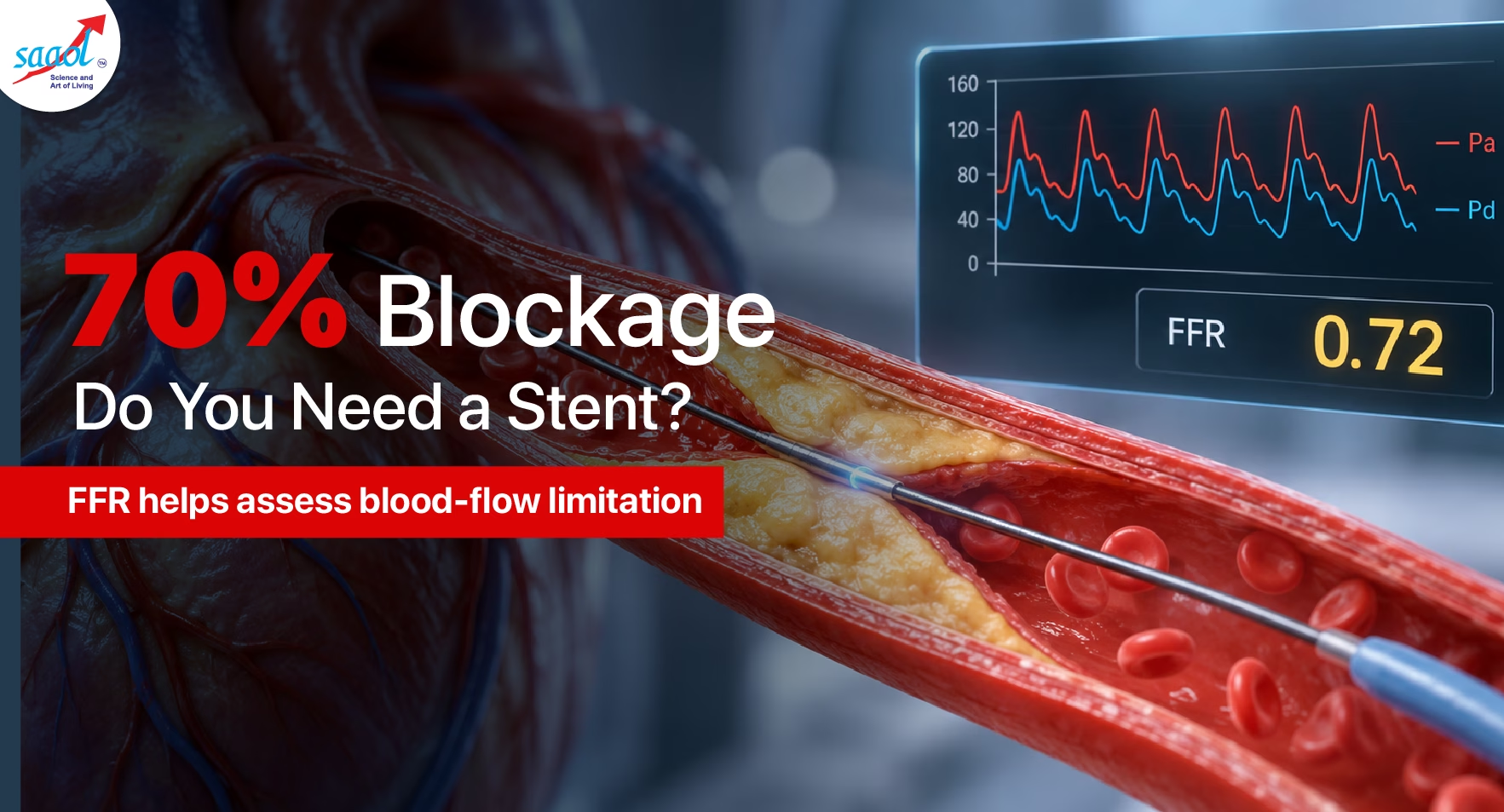
FFR stands for fractional flow reserve. It measures how much a coronary artery narrowing affects blood flow to the heart muscle. When angiography shows an intermediate narrowing, FFR can help doctors decide whether treating that particular lesion with a stent is likely to provide benefit. However, the FFR number is not used alone; symptoms, artery anatomy, other tests and the patient’s overall condition also matter.
You may have heard someone say, “Your artery has a 70% blockage,” and immediately thought: Does that mean I need a stent?
It is an understandable question. A percentage sounds like a clear answer, but it describes how narrow an artery looks. It does not always show how much that narrowing affects blood supply. That is where FFR can help.
Let’s break down what the FFR test for the heart measures, what happens during the procedure, and what its result means for your treatment.
What is FFR, and what does it actually measure?
Fractional flow reserve (FFR) is a measurement that shows whether a narrowing in a coronary artery significantly limits blood supply to the heart muscle. It helps doctors understand how the narrowing affects blood flow, beyond how it looks on a scan.
Your coronary arteries carry oxygen-rich blood to the heart muscle. When plaque builds up inside one, the space for blood to pass through becomes narrower. Doctors call this a stenosis.
A coronary angiogram uses contrast dye and X-rays to show the narrowing. FFR answers the next question: When your heart needs more blood, how much does this narrowing get in the way?
Think of an artery as a road. The angiogram shows where the road narrows; FFR helps assess how much that narrow stretch slows the traffic.
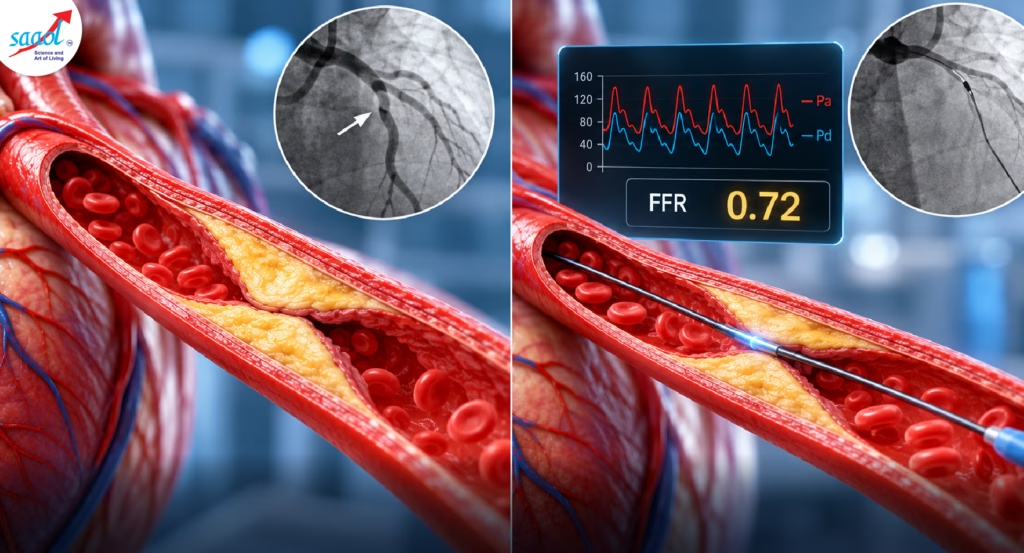
To calculate FFR, a cardiologist uses a pressure-sensing wire to measure pressure beyond the narrowing and compares it with pressure in the aorta, the main artery leaving the heart.
Traditional FFR uses medication such as adenosine to increase coronary blood flow during the measurement. Other pressure-based tests, such as iFR, can assess a lesion without inducing hyperemia with adenosine.
The result is a ratio, such as 0.76 or 0.86, as described by Cleveland Clinic. It does not mean the artery is 76% or 86% blocked.
Why would your doctor recommend an FFR test?
FFR is most useful when an angiogram shows a narrowing but the doctor is unsure whether that spot is restricting blood supply enough for a stent to be helpful.
That uncertainty often arises with an intermediate narrowing: one that is clearly visible, yet whose effect cannot be judged confidently from the image alone. The American Heart Association notes that pressure-based assessment can help guide decisions for such narrowing’s.
For example, two people might both be told they have a “70% blockage.” The narrowing’s may sit in different arteries and affect blood supply differently. Their symptoms, other health conditions and test results may also differ. The blockage percentage matters, but it does not make the treatment decision by itself.
If your angiogram report mentions a 70% narrowing, you may be wondering whether angioplasty is necessary for a 70% heart blockage. Your cardiologist may consider the FFR result alongside your symptoms and other findings before recommending treatment.
What happens during the FFR cardiology procedure?
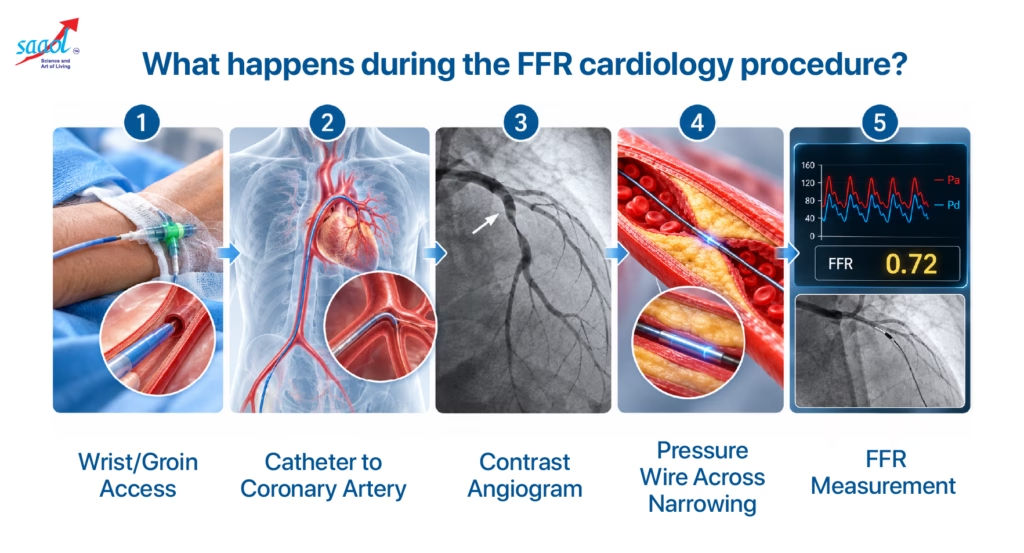
Invasive FFR is usually measured during a coronary angiogram. Here is the usual sequence:
- The access site is cleaned and numbed with local anaesthetic.
- A thin catheter is inserted through an artery, usually at the wrist or sometimes the groin, and guided to the coronary arteries.
- Contrast dye makes the arteries visible on X-rays.
- A pressure-sensing wire passes across the narrowing.
- A medication such as adenosine may be given to temporarily increase coronary blood flow so the pressure difference across the narrowing can be assessed under stress conditions.
Your medical team monitors you throughout the procedure
What Should You Tell Your Medical Team Beforehand?
Mention any kidney problems, contrast-dye reactions, allergies and medicines you take.
Follow the hospital’s instructions about food, drinks and medicines before the angiogram.
Do not stop a prescribed medicine unless your treating team tells you to.
Is FFR Risky?
FFR involves a wire measurement during an invasive angiogram, so the risks of catheterisation matter. Possible complications include:
- Bleeding or bruising where the catheter enters the artery
- An allergic reaction to the contrast dye
- Kidney problems related to the contrast dye
- Injury to a blood vessel
Serious complications are uncommon. Your doctor can explain which risks apply to you based on your health and the planned procedure.
What Does an FFR Result of 0.80 Mean?
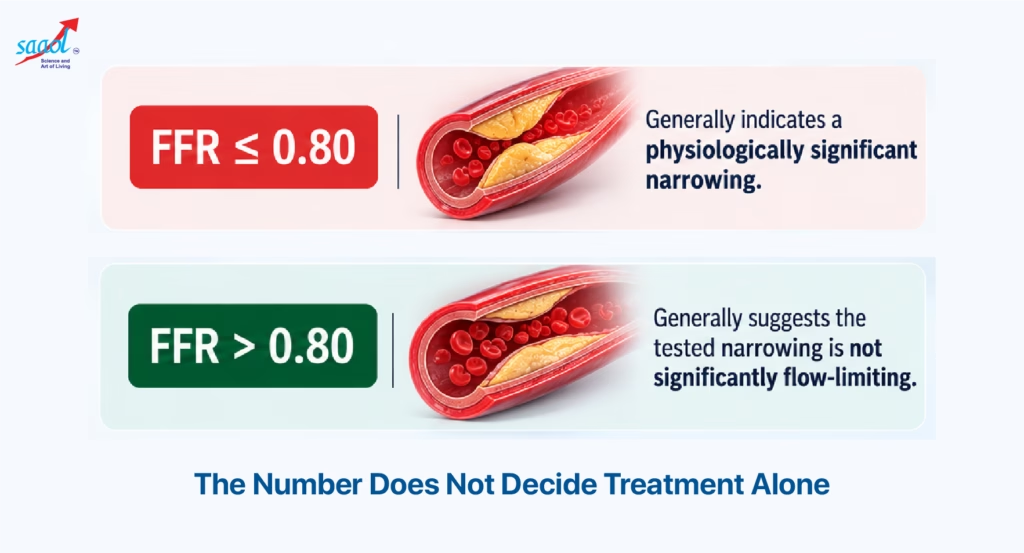
The number 0.80 is commonly used as a decision threshold:
- FFR of 0.80 or lower: Generally indicates that the narrowing is physiologically significant and may support revascularization when considered alongside symptoms, anatomy, clinical findings and the overall treatment plan. It does not automatically mean that a stent is required.
- FFR above 0.80: The narrowing is generally not considered significantly flow-limiting under test conditions, which may support managing that narrowing without a stent.
The number does not decide treatment by itself. Your doctor also considers your symptoms, the artery involved and your other test results. A reading of 0.79 does not automatically mean you need a stent, and 0.81 does not mean your symptoms should be ignored.
The American Heart Association recommends interpreting FFR in the context of the person being treated.
FFR cannot tell you with certainty whether you will have a future heart attack. It assesses how a narrowing affects blood supply during the test; it does not assess every aspect of plaque or heart-attack risk.
How Can FFR Help Doctors Choose Treatment?
An FFR result may help your cardiologist decide whether treating a particular narrowing with a stent is likely to be useful. It can also help avoid placing a stent in a narrowing that is not substantially restricting blood supply.
In the 2009 FAME trial published in The New England Journal of Medicine,researchers studied 1,005 patients with narrowing in multiple coronary arteries. They compared stenting decisions guided by angiography alone with decisions guided by angiography plus FFR.
In the FAME trial, an FFR-guided strategy resulted in fewer stents being placed and a lower rate of the trial’s composite outcome of death, myocardial infarction or repeat revascularization at one year compared with angiography-guided PCI.
The findings support using physiological assessment to guide PCI decisions in appropriate patients; they do not mean that every lesion with an abnormal FFR automatically requires a stent.
Your options may include medicines, a stent, bypass surgery and changes to address cardiovascular risk factors. The right choice depends on the wider picture:
- Your symptoms
- Which artery is affected
- The pattern of disease
- Your general health.
CT Angiography vs Invasive FFR: What’s the Difference?
| CT angiography | Invasive FFR | |
| What to investigate | Where are the coronary arteries narrowed? | Is a particular narrowing significantly restricting blood supply? |
| How it works | A CT scan creates images of the arteries using contrast dye | A pressure-sensing wire measures pressure across a narrowing during a coronary angiogram |
| Catheter needed? | No | Yes |
| When it may help | When a doctor needs to examine the coronary arteries | When a narrowing is visible but its effect on blood supply is uncertain |
CT-FFR (also called FFR-CT) is different from invasive FFR. It uses data from a coronary CT angiography scan and computer-based analysis to estimate the physiological significance of a coronary narrowing without passing a pressure wire through the coronary artery.
What should you do if your FFR result leaves you confused?
Ask your cardiologist to show you which artery was measured and explain how the result connects to your symptoms. You can also ask:
- What was my FFR value, and what does it suggest for this artery?
- Do my other test results point in the same direction?
- What could each treatment option help me achieve?
- If a stent is not recommended now, what is my treatment and follow-up plan?
- Which change in symptoms should prompt me to seek help?
Understand Your FFR Result Before Deciding on Treatment
A heart report can feel overwhelming when it is reduced to one number. You deserve to know what that number means before making a decision.
If you would like to discuss your angiogram, FFR result and treatment options, book a consultation with SAAOL Heartcare Delhi and bring your reports and current medicine list.
FAQs
Q1. What is the difference between FFR and ejection fraction?
FFR measures the effect of an artery narrowing on blood supply, while ejection fraction measures the heart’s pumping function. Ejection fraction, or EF, is the percentage of blood the heart’s main pumping chamber pushes out with each beat. The two measurements answer different questions and cannot replace each other.
Q2. Can I still have chest pain if my FFR result is normal?
Yes. A normal FFR for one coronary narrowing does not rule out every possible cardiac cause of chest pain. Symptoms may arise from other coronary lesions, coronary microvascular dysfunction, vasospasm or non-cardiac causes. Persistent or changing symptoms should be discussed with your cardiologist.
Q3. What is the difference between FFR and iFR?
Both assess whether an artery narrowing affects blood supply, but they measure pressure under different conditions. FFR usually uses medication to maximise blood flow. iFR, or instantaneous wave-free ratio, measures pressure during a specific part of the heartbeat without that medication, as explained by Cleveland Clinic.
Q4. Can FFR be measured after a stent has been placed?
Yes. A cardiologist may measure FFR after stent placement to assess whether blood supply remains restricted. This can help evaluate the overall result, including the effect of other narrowings in the same artery. It is used selectively rather than automatically after every stent procedure.
Q5. How long does an FFR test take?
The total time depends on the angiogram and whether treatment is performed during the same procedure. The FFR measurement adds time to the angiogram, while stent placement takes longer. You will also need preparation and recovery time, so ask your hospital how long to allow for the complete visit.
Q6. Can I go home on the same day after an FFR test?
Some patients can go home the same day, while others need an overnight stay. This depends on their health, recovery and whether another procedure was performed. Follow your team’s instructions about driving, lifting and exercise; the National Heart, Lung, and Blood Institute explains that additional procedures can affect the hospital stay.
Disclaimer: This article is for general education. It cannot diagnose a heart condition or replace advice from your treating doctor, who must interpret test results in the context of your full medical history.
Book Appointment





In This Article
- What is FFR, and what does it actually measure?
- Why would your doctor recommend an FFR test?
- What happens during the FFR cardiology procedure?
- What Should You Tell Your Medical Team Beforehand?
- Is FFR Risky?
- What Does an FFR Result of 0.80 Mean?
- How Can FFR Help Doctors Choose Treatment?
- CT Angiography vs Invasive FFR: What’s the Difference?
- What should you do if your FFR result leaves you confused?
- Understand Your FFR Result Before Deciding on Treatment
- FAQs
×
Request for a Call Back
Thank You! We'll get back to you shortly.