
One minute you’re joking with your kids, the next you’re holding your chest. What if we told you that to avoid heart disease, it is not just about food or exercise, and that it is not just for the old? You, at this moment at whatever age, at any state are either unknowingly walking toward a cardiac event, or mindful of stepping away from one. And it all depends on how deep your awareness of span is. Most patients at SAAOL Heartcare Delhi are shocked to discover severe heart blockages despite following “healthy” habits. This is because heart disease often develops silently and is not just linked to food, age, or weight. In this blog, some unconventional information is laid down, coming from the 30+ years of non-invasive heart treatment expertise of Dr. Bimal Chhajer. You already eat less oily food, walk 30 minutes daily, and perhaps take a multivitamin. So you should be safe, right?
No. And here’s why.
You Can Look Fit and Still Have Heart Disease
Let’s explode one giant misconception right out of the gate: You don’t have to be overweight to get heart disease. Indeed, some of the more tragic heart attacks have happened to peak physical shape actors, and 30-something non-smokers who ran marathons. Why?
Heart disease is not only caused by fat build-up. It is driven by inflammation, oxidative stress, genetics, and endothelial dysfunction, a condition where blood vessels lose their ability to expand properly.
Your arteries are flexible, like a garden hose. They should stretch and shrink readily. But micro-damage from sugar spikes, smoking, high blood pressure, bad cholesterol (the small dense LDL type), and chronic stress has stiffened them up for years. They become less elastic, and one day, they give under pressure.
Blood Tests That Predict Heart Disease Early
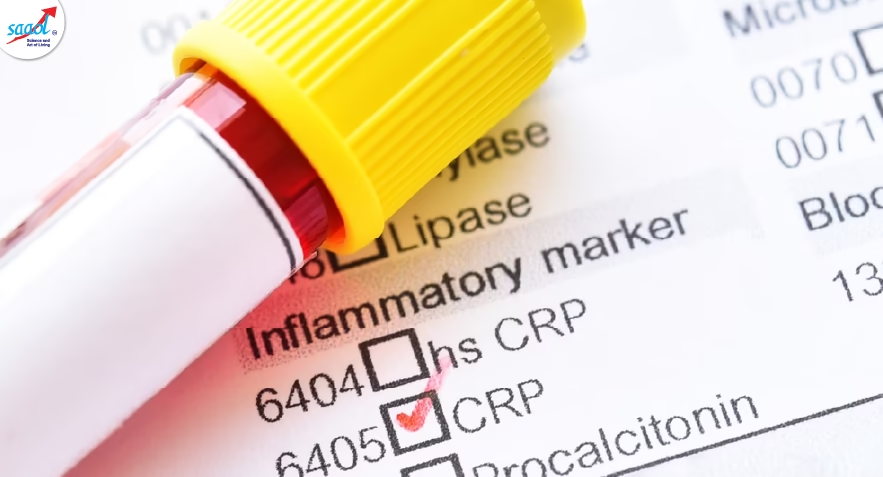
People obsess over LDL cholesterol. But there is a more urgent and more predictive marker: Lipoprotein(a) or Lp(a). It’s genetic; it doesn’t respond to lifestyle changes, and most doctors don’t test for it.
Likewise, hs-CRP (high-sensitivity C-reactive protein) provides insight into inflammation in the body. A ticking time bomb. If this is high, you’re not safe, even if your cholesterol is “normal.”
Now we need to discuss homocysteine a toxic by-product of protein metabolism that will damage your arteries if it gets too high. It’s like acid dripped on your vessel walls. Nobody looks at it unless it’s too late.
Do you still think your average annual check-up will be enough?
How Chronic Stress Silently Damages Your Heart
Chronic emotional stress might be worse than smoking.
What we know now is that emotional stress, especially the kind we suppress (unhealed grief, relationship trauma, overworking, financial fear), releases cortisol and adrenaline in waves that wear out your heart like sandpaper. Those who live with emotional pain have elevated resting heart rates, higher blood pressure, and increased inflammatory markers.
Your heart does not only beat for your body. It responds to your thoughts. Every single one of them.
Big Names, Big Buzz to Avoid Heart Disease
We’re living in the biohacking age. Everyone wants the shortcut. The superfood. The one test. But let us flip the script. Preventing heart disease isn’t a one-day job. It goes a long way with smart choices and Non-invasive treatments like EECP (Enhanced External Counterpulsation) help improve blood flow, reduce angina, and support natural collateral vessel formation without surgery..
It looks like:
- Getting up at the same time every day.
- Get sunlight within half an hour of waking.
- Sleeping before 11 PM.
- Avoiding sugar is not just because of diabetes, but because every sugar spike inflames your arteries for hours.
- Managing insulin resistance before you even become diabetic.
Yes, you read that right. Metabolic syndrome is the iceberg tip of heart disease: insulin resistance is its unsung villain. And even if your fasting glucose is good, your cells could be having a hard time using insulin appropriately. It means your pancreas just keeps pumping it out, causing fat storage, arterial damage, and hypertension.
Test: Ask your doctor for a fasting insulin test. Not just sugar. Insulin.
How Early Detection Helps: The Power of Early Diagnosis

Want a real wake-up call? Get a Coronary Artery Calcium (CAC) Score test. It takes 10 minutes. No needles. It indicates how much calcified plaque is lying silently in your arteries.
Or, even better, an Endothelial Function Test, which gives you a measure of how dilated your arteries are. It’s like a performance check on your blood vessel.
Don’t wait for pain. Chest pain is a late symptom. The idea is to find dysfunction before it progresses to disease.
What to Eat to Avoid Heart Disease Naturally
Yes, what you eat matters. But don’t do calorie counts, do inflammation points.
Here are some heart-healthy, under-the-radar foods:
- Beets or Beetroot- they raise nitric oxide and enhance vascular function
- Pomegranate- proven to dissolve some arterial plaque
- Flaxseeds- high in ALA, lowers blood pressure
- Dark Chocolate (85 %+)- Acts as an Endothelial Vasodilator
- Turmeric with black pepper- natural anti-inflammatory
Don’t eat anything that spikes insulin and oxidizes your cholesterol: refined carbs, deep-fried snacks, reheating oils (yes, your samosa shop is guilty), and excess alcohol.
And for goodness’ sake, Adopting zero-oil cooking, as recommended by Dr. Bimal Chhajer, significantly reduces arterial inflammation while maintaining taste and satiety.
Best Exercises for Heart Disease Prevention
Walking is great. But walk like you mean it. Heart health requires zone 2 cardio the kind you can talk through but not sing. It strengthens your mitochondria (your cell’s energy factories) and improves fat metabolism.
Get sweaty with strength training 2x a week. More muscle means better glucose disposal. And no, lifting is not going to make you bulky. It will make you insulin-sensitive.
Stretch. Do yoga. But don’t assume some stretching will counter 20 hours of sitting. Set a timer every hour. Walk for 3 minutes. That’s known as microcirculation support. You’ll thank yourself later.
Why Mental Health Is Critical for Heart Health
A heart-focused blog of SAAOL Heartcare Delhi can’t skip the most important part: your mind.
Do a stress audit. How many minutes a day do you spend in fight-or-flight mode?
- Practice box breathing (4 seconds as you inhale, hold for 4, 4 seconds as you exhale, 4 hold).
- Meditate not to find peace, but to reboot your nervous system.
- Connect Relationships are protective. Isolation is inflammatory.
Heart Supplements That May Help (With Medical Guidance)
If you’re already doing all of the above and still worrying, here are a few additions supported by science:
Omega-3 (EPA – Eicosapentaenoic Acid)
- Helps lower triglyceride levels, which are fats in your blood that can contribute to artery plaque buildup.
- Known for its anti-inflammatory effects, which are crucial in calming chronic inflammation inside blood vessels, a hidden driver of heart disease.
CoQ10 (Coenzyme Q10)
- Plays a key role in producing energy (ATP) within heart muscle cells your heart needs a massive supply of energy to beat continuously.
- Acts as a powerful antioxidant, protecting heart tissues from oxidative stress, especially important if you’re on statins (which can lower CoQ10 levels).
Magnesium
- Acts as a natural vasodilator, helping blood vessels relax and expand this eases blood pressure and improves circulation.
- Supports over 300 biochemical reactions, many of which are vital for stable heart rhythms and muscle function.
Vitamin K2 (particularly MK-7 form)
- Helps redirect calcium away from arteries, where it can cause hardening and blockages, and moves it into the bones where it belongs.
- Works in synergy with vitamin D3 and magnesium to maintain artery flexibility and prevent calcification.
Berberine
- A plant-derived compound that improves insulin sensitivity, helping to regulate blood sugar levels naturally.
- Reduces LDL cholesterol and triglycerides, showing statin-like effects without the same side effects for some people.
But don’t self-prescribe. Get tested. Know your numbers. Track your data.
Conclusion: The Heart Listens
Yes, staying free of heart disease involves work. But here’s the thing: your heart is listening. Every kindness you do to yourself walking, real meal, deep sleep, hugging your child, saying no to drama it hears that. And it beats stronger.
You are not at war with your body. You are collaborating with it. Begin now. Don’t wait for symptoms to avoid heart disease.
Not all heroes wear capes. Others simply opt to pause, breathe, and take the stairs today.
Your heart responds to every daily choice. The earlier you act, the easier it becomes to avoid heart disease and live actively without waiting for symptoms.